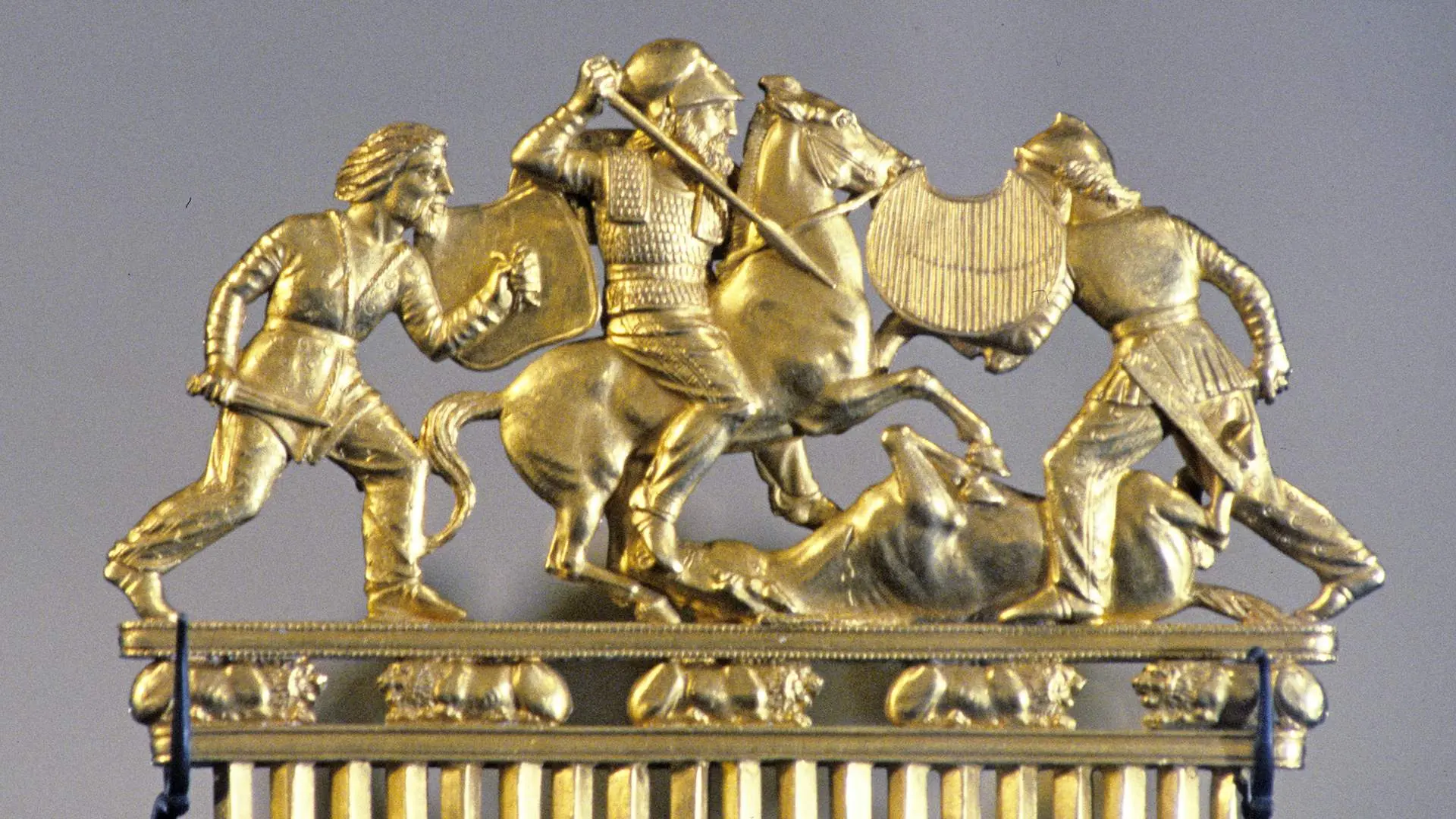
History often presents the Scythians simply: a nomadic people without cities or a state, whose economy was based on livestock and warfare. Their culture, apparently, was simple. Yet on this backdrop emerges a remarkable paradox: Scythian gold.
Collections from kurgans in the Black Sea region, Kuban, Altai, and the Lower Don reveal items of extraordinary sophistication: fine granulation, filigree, lost-wax casting, multi-figure compositions, symbolism, and artistic unity. These objects are among the finest examples of ancient Eurasian jewelry.
The question arises: how could nomads create such advanced goldwork?
The “Greek Craftsmen” Theory: Convenient, But Flawed
The traditional explanation is that Scythians did not make the jewelry themselves, but ordered it from Greek artisans in colonies such as Olbia, Panticapaeum, and Chersonesus.
While plausible at first glance, this theory encounters contradictions:
- Jewelry of such complexity implies the presence of elite patrons with inherited status and social hierarchy.
- But nomads are portrayed as people “whose homeland is wherever they stop.” Which elite could commission multi-figure gold pectorals under such conditions?
- Furthermore, these “commissioned” works often surpass Greek jewelry in complexity and artistry, raising the question: why would an artisan produce his best work for foreign patrons while creating simpler pieces for his own society?
Scythian Animal Style: Original and Canonical
The so-called Scythian animal style features:
- Strict canonical motifs repeated across a vast territory;
- Transformations of predator and prey in intricate compositions;
- An internal symbolic system distinct from Greek aesthetics.
This suggests that the tradition was internal to Scythian culture, not merely executed by Greek craftsmen on commission.
Nomads ≠ Primitive
Equating nomadic life with primitiveness is misleading. Nomadic societies could:
- Have specialized craftsmen;
- Move workshops with the tribe;
- Concentrate resources through raids, tribute, and trade;
- Preserve complex techniques without urban centers.
Historical examples (Huns, Mongols) demonstrate that nomadic civilizations could be highly organized and technologically advanced.
Alternative Hypothesis
Many scholars now believe that:
- Much of Scythian gold was produced within the Scythian cultural sphere;
- Greek artisans may have participated, but did not dominate;
- Some masters may have been Scythians trained in complex techniques.
In short, the image of “nomadic barbarians” underestimates their social complexity and artistic achievement.
Conclusion
Scythian gold challenges conventional narratives. The facts are undeniable:
- Artistry is world-class;
- Symbolism is consistent;
- Elite structures are evident;
- Techniques are sophisticated.
Perhaps the problem lies not with the Scythians, but with our outdated notions of what a civilization must look like.