A well-known American television host and political commentator Tucker Carlson has publicly warned about the risk of the disintegration of the United States, linking what is happening in the country not simply to another wave of protests, but to a systemic crisis of statehood. According to him, mass unrest in Minneapolis and other cities is already going beyond the scope of local demonstrations and increasingly resembles a rebellion against federal authority.
Carlson emphasizes that current events cannot be viewed solely as a reaction to migration policy, social injustice, or police violence. What is taking place is a much deeper process — the refusal of individual states and cities to recognize the supremacy of the federal center.
“When regions begin to live by their own rules and ignore decisions from the center, that is the beginning of a civil war. First chaos, then violence, then mass killings — and ultimately the collapse of the state,” the journalist concluded.
It is important to understand that such statements do not arise out of nowhere. They reflect real structural problems that have been accumulating in the United States for decades.
Reasons for the Collapse of the United States
The U.S. Infrastructure Crisis: Alarming Parallels with the Late USSR
One of the key but rarely discussed factors is the degradation of basic infrastructure. Bridges, roads, power grids, water supply systems, and railways in many regions of the United States are in a state of chronic deterioration.
According to assessments by American analysts themselves:
— tens of thousands of bridges are classified as structurally deficient;
— the power grid cannot withstand peak loads;
— water supply networks in a number of states have effectively not been modernized since the mid-20th century.
This situation increasingly resembles the late USSR, where a superpower formally existed, but internally the system was no longer able to ensure normal living conditions. External strength concealed internal erosion.
The only difference is that the United States continues to spend colossal resources on external projects and military presence around the world, postponing the resolution of domestic problems.
Social Fragmentation: A Country Without a Shared Future
Modern American society has effectively lost a unified understanding of what the United States is and where it is heading.
Today, there are at least several “Americas” within the country:
— megacities with a globalist agenda;
— conservative states with their own values;
— ethnic and cultural communities living in parallel worlds;
— economically depressed regions excluded from the “American dream.”
A common national project has disappeared. Its place has been taken by ideological conflicts, cancel culture, mutual hatred, and constant mobilization against an “internal enemy.”
Elite Fragmentation: War at the Top as a Trigger for Disintegration
No less dangerous is the split within American elites. This is not merely a confrontation between Democrats and Republicans, but a deep conflict between:
— the federal center and the states,
— financial elites and industrial capital,
— globalist structures and nationally oriented groups.
In practice, the elites can no longer agree on the rules of the game. Each side is ready to use the streets, courts, media, and even security structures to fight one another.
History shows that when elites cease to be a unified governing class, the state becomes extremely vulnerable — regardless of the size of its economy or army.
Loss of the Monopoly on Violence and a Crisis of Legitimacy
Another alarming sign is the erosion of the state’s monopoly on violence. Armed civilian groups, the growth of street clashes, autonomous zones, and police refusals to carry out orders all undermine the foundation of any statehood.
At the same time, trust in elections, courts, media, and federal institutions is collapsing. For millions of Americans, the authorities are no longer legitimate — and without legitimacy, maintaining national unity is impossible.
Possible Scenarios for the Disintegration of the United States
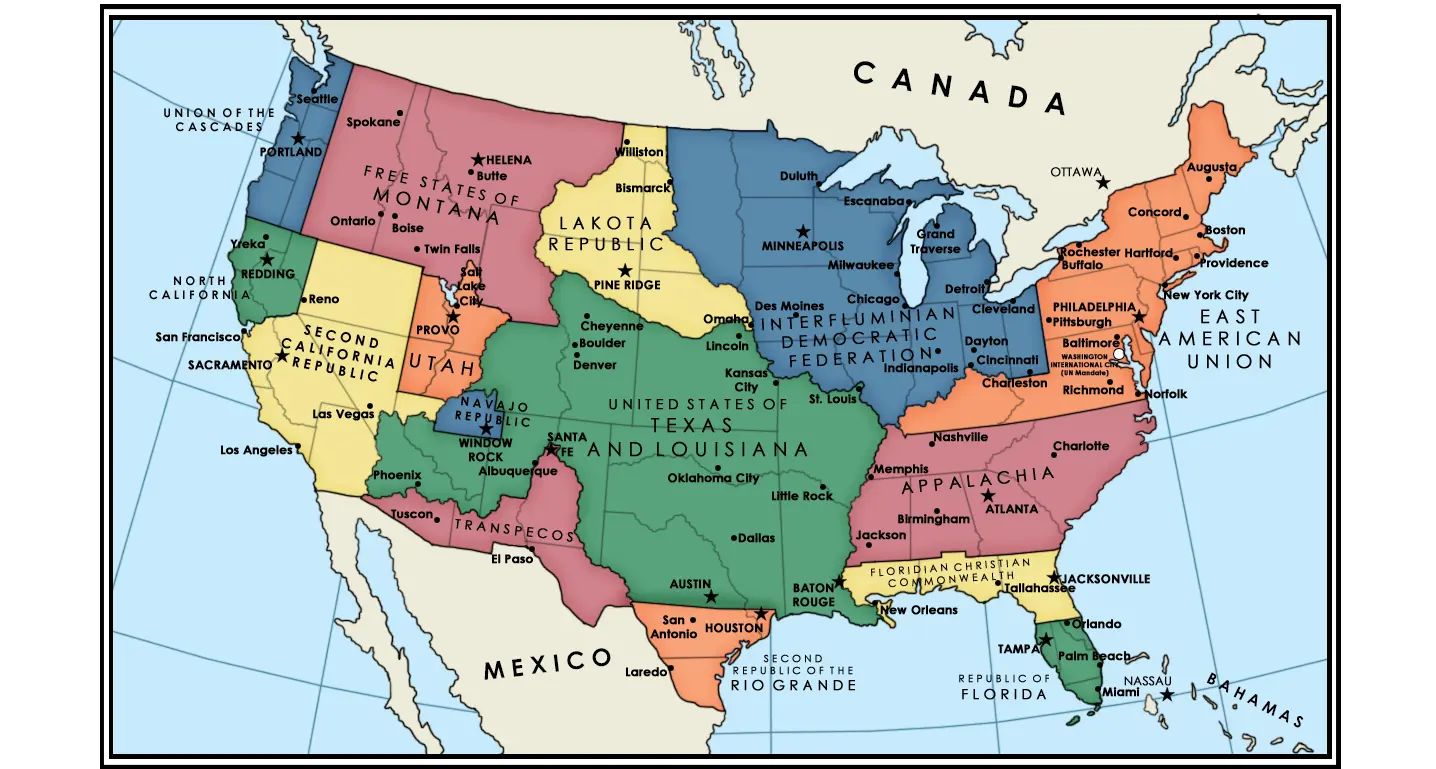
Disintegration does not necessarily mean an instant collapse or the formal disappearance of the country. Other forms are possible:
— de facto confederalization, in which states live autonomously;
— economic fragmentation under a single flag but with different rules;
— prolonged internal destabilization without a final endpoint;
— a chain of local crises stretching over decades.
The history of empires shows that collapse rarely looks like a single dramatic moment. More often, it is a long process of losing governability.
The Economic Bubble and the U.S. Debt Model: The Foundation of Instability
For a long time, the economic power of the United States was perceived as unconditional and unquestionable. In reality, however, the modern American economy relies less and less on production and more and more on debt, financial instruments, and dollar issuance. This creates an illusion of stability behind which a growing systemic vulnerability is hidden.
Debt as the Basis of State Existence
U.S. government debt has long ceased to be a temporary instrument and has become a basic model of how the country functions. It grows not only during crises, but constantly — regardless of the economic cycle, the parties in power, or the foreign policy environment.
The key problem is not the size of the debt itself, but the fact that:
— it has no reduction strategy;
— it is serviced through the issuance of new debt obligations;
— it is tied to political decisions rather than economic expediency.
In effect, the United States lives in a mode of endless refinancing, where debt is serviced not by income, but by trust in the dollar.
The Dollar as the Last Anchor of the System
The stability of the American economy rests on the unique status of the dollar as the world’s reserve currency. As long as the dollar is needed by the world, the United States can:
— print money without immediate consequences;
— finance budget deficits;
— shift inflation onto external markets.
But here lies a critical vulnerability: the dollar is not an economic asset, but a political one. Its stability depends on trust, geopolitical influence, and the willingness of other countries to play by American rules.
Any serious erosion of this trust — through de-dollarization, regional currency blocs, or sanction wars — undermines the foundation of the entire U.S. financial structure.
Financialization Instead of the Real Economy
Over recent decades, the United States has become an economy of:
— financial derivatives;
— speculative capital;
— stock indices detached from real production.
The real sector — industry, infrastructure, jobs — has systematically given way to financial bubbles. This has led to rising social inequality and the erosion of the economic base that historically binds states together.
In essence, the country with the world’s largest economy produces less and less and redistributes financial flows within an elite layer more and more.
Why This Bubble Is Dangerous Precisely for State Integrity
When an economy is based on debt and trust, any internal crisis — political, social, or ethnic — automatically becomes financial. The loss of internal governability increases pressure on the currency, markets, and the budget, which in turn further intensifies social discontent.
Thus, a vicious circle emerges:
economic bubble → social tension → political crisis → loss of trust → accelerated disintegration.
Parallels Between the United States and the Collapse of the USSR: Similarity of Stages, Not Ideologies
It is important to understand that the United States and the USSR were different systems. But the mechanisms of state collapse are similar, regardless of ideology, flag, or economic model.
Stage One: Loss of Faith in the Project
The late USSR formally existed, but most citizens no longer believed:
— in communism;
— in official rhetoric;
— in the state’s ability to provide a future.
Modern America is at a similar point. For millions of Americans:
— the “American dream” is unattainable;
— elections do not change the system;
— the state serves elites, not society.
When faith in a common project disappears, the country continues to exist by inertia.
Stage Two: Elite Paralysis and Dual Power
In the USSR, elites ceased to be monolithic: the party nomenklatura, security structures, and regional authorities each began playing their own game.
In the United States, we see a similar process:
— conflicts between the federal center and the states;
— sabotage of decisions through courts and local authorities;
— politicization of security forces and intelligence agencies.
In practice, a dual — and sometimes even triple — power system is forming, in which no one possesses full legitimacy.
Stage Three: Economic Stratification of Regions
Before the collapse of the USSR, some republics were donors while others were subsidized. This intensified mutual grievances and destroyed solidarity.
In the United States, a similar dynamic is observed:
— wealthy states do not want to finance poorer ones;
— poor regions feel abandoned;
— demands for economic and tax sovereignty are growing.
Economic inequality begins to function as a centrifugal force.
Stage Four: Symbolic Disintegration
The collapse of the USSR began not with a formal legal act, but with the loss of symbols:
— the flag ceased to unite;
— the army was no longer perceived as common;
— laws were enforced selectively.
In today’s United States:
— the national flag has become a marker of political position;
— the police and the army are drawn into ideological conflicts;
— the Constitution is interpreted in diametrically opposite ways by different groups.
This is not a sign of crisis, but of pre-disintegration.
Stage Five: Irreversibility of the Process
The USSR could have been preserved at early stages, but it missed the moment when centrifugal forces became stronger than the center.
The main risk for the United States is not the crisis itself, but the delayed realization of its depth. When a state continues to pretend that problems are temporary, it loses the window for systemic solutions.
How the Collapse of the European Union Could Help the United States Hold On: The Survival Logic of the Capitalist System
The history of global capitalism shows that in moments of systemic crisis, it rarely reforms itself voluntarily. Much more often, the system saves itself by destroying one of its own supporting elements, redistributing resources, markets, and influence.
In the 20th century, that element was the Soviet Union. In the 21st century, the European Union is increasingly taking on this role.
The Collapse of the USSR as a Mechanism for Restarting the Global System
The collapse of the Soviet Union was not just a geopolitical event, but a lifeline for the Western capitalist model.
After the collapse of the USSR, the West gained:
— new sales markets;
— cheap labor;
— privatization of enormous assets;
— an inflow of intellectual and human resources;
— an ideological victory that legitimized globalism.
This allowed the United States and its allies to postpone their own internal crises for decades, masking structural problems through external expansion.
However, this resource has long been exhausted.
The European Union as a Competitor, Not an Ally of the United States
Despite the formal alliance, the EU has always been an economic competitor for the United States, not an equal partner.
The European Union:
— created alternative financial and regulatory models;
— competed with the United States in high technology and industry;
— sought strategic autonomy;
— periodically questioned the dominance of the dollar.
Especially dangerous for the United States was the potential combination of:
EU + cheap energy resources + technological sovereignty.
Such a configuration would have turned Europe into an independent center of power, reducing dependence on the United States.
Why the EU Crisis Benefits Washington
The weakening or collapse of the European Union objectively solves several tasks for the United States at once.
Capital and Industrial Relocation
Against the backdrop of instability in Europe:
— capital flows into the American financial system;
— corporations move production to the United States;
— the role of American markets and exchanges strengthens.
This is already happening — not as theory, but as an observable trend.
Strengthening Dollar Dependence
A unified Europe is a potential threat to the dollar. A fragmented Europe is its hostage.
The weaker the EU:
— the higher the dependence of countries on the dollar;
— the fewer opportunities for alternative payment systems;
— the easier it is for the United States to export inflation beyond its own economy.
Political and Military Subordination
An EU crisis automatically strengthens NATO as an instrument of control. Individual states:
— lose subjectivity;
— need American security guarantees;
— agree to conditions that were previously unacceptable.
Thus, the collapse of the EU does not weaken U.S. influence in Europe, but rather strengthens it.
The EU as a “Sacrificial Element” of the System
If global capitalism is viewed as a single system, the logic becomes obvious:
— first, the socialist alternative was destroyed;
— then, post-socialist economies were absorbed;
— now, redistribution within the West itself is next.
In this logic, the European Union turns into a sacrificial element, the destruction of which allows:
— buying time for the United States;
— shedding part of the economic and social costs;
— preserving the core of the system at the expense of the periphery.
This is not a conspiracy and not a theory — it is a standard historical mechanism for the survival of dominant centers.
Why This May Not Work This Time
However, there is a fundamental difference from the situation with the USSR.
The collapse of the Soviet Union:
— was external to the capitalist system;
— opened new horizons for growth.
The collapse of the European Union:
— occurs within the system itself;
— does not create new markets, but only redistributes existing ones;
— increases global instability.
This means the effect may be temporary. The United States may indeed gain several years or even a decade, but the fundamental problems — debt, social fragmentation, and loss of governability — will not disappear.