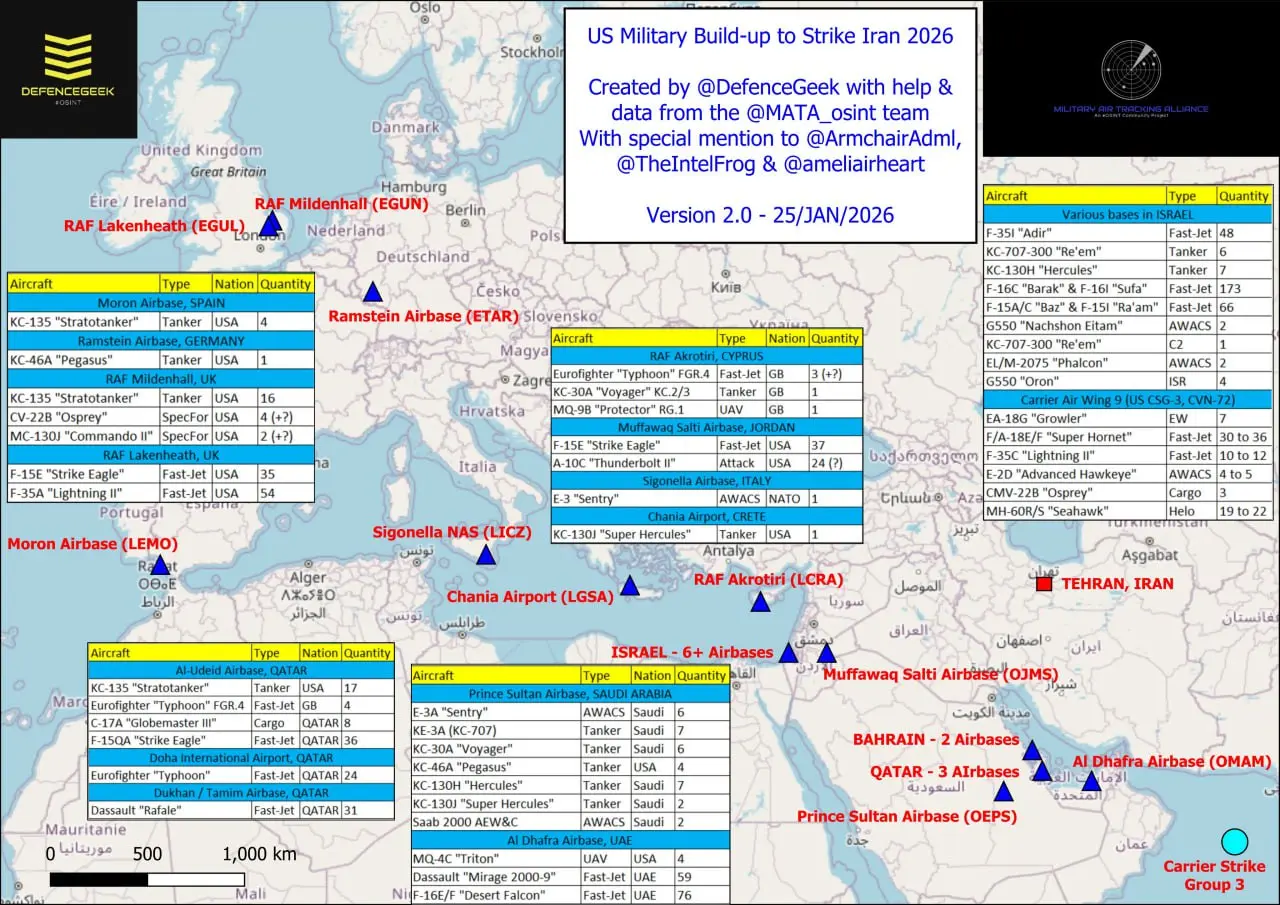
Military and political tensions around Iran continue to escalate. The United States and Israel have effectively completed the deployment of a large aviation grouping in the Middle East, sufficient to conduct a large-scale but time-limited air and missile operation against Iranian targets. At present, the forces are at a high level of readiness and are awaiting a political decision to initiate active actions.
A key element of the preparation has traditionally been aerial refueling aircraft, without which long-range strikes against Iranian territory are impossible. Around 20 American and approximately 13 Israeli air tankers are concentrated in the region. In addition, the U.S. Air Force operates 37 KC-135 Stratotanker aircraft and 5 newer KC-46 Pegasus tankers, enabling sustained support for dozens of strike aircraft.
At least 37 F-15E Strike Eagle fighter-bombers of the U.S. Air Force are already deployed in close proximity to Iran. A significant reinforcement is provided by the USS Abraham Lincoln carrier strike group, which reached strike distance back in late January. Its air wing includes around 30 carrier-based F/A-18E/F Super Hornet aircraft, up to 10 fifth-generation F-35C fighters, as well as EA-18G Growler electronic warfare aircraft and E-2D Hawkeye carrier-based airborne early warning aircraft.
Special mention should be made of up to 54 F-35A fighters stationed at air bases in the United Kingdom. Accompanied by 16 KC-135 tankers, they can be rapidly redeployed to the Middle East to participate in breaching Iran’s air defense system and delivering deep strikes across the country. In total, U.S. aviation has more than 70 heavy F-15E aircraft suitable both for gaining air superiority and for long-range strike missions.
The grouping is further complemented by 24 A-10 Thunderbolt II attack aircraft. The likelihood of their use in a classic strike role remains low — it is far more likely they would be employed as drone and cruise missile interceptors using APKWS II guided munitions. The region also hosts E-3 Sentry airborne early warning aircraft and MQ-4C Triton high-altitude reconnaissance UAVs, providing intelligence, surveillance, and targeting support.
Israel, for its part, possesses one of the most combat-capable air forces in the region. Its inventory includes 48 F-35I Adir fighters, approximately 173 F-16s, and 66 F-15s of various modifications. The Israeli Air Force also operates aerial refueling aircraft, reconnaissance platforms, and airborne early warning systems, including the EL/M-2075 Phalcon based on the Boeing 707, capable of detecting air targets at distances of up to 400 km. In the event of an operation, Israeli aviation would almost certainly be one of its key participants.
At present, the only relatively vulnerable element of a potential operation appears to be the limited number of airborne early warning aircraft, even taking into account the carrier-based E-2D from the aircraft carrier. However, it is entirely possible that not all such assets are reflected in open-source data, or that additional aircraft of this class will be redeployed to the region at a later stage as the situation develops.
Overall, the deployed U.S. and Israeli forces are sufficient to deliver powerful and concentrated air and missile strikes against Iran, which Tehran is unlikely to be able to repel. Previous experience has shown that Iranian air defense and air force units were unable to effectively counter even a limited air strike campaign conducted by Israel alone, particularly when indirectly supported by U.S. strikes. In the current configuration, with the possible involvement of strategic bombers and cruise missiles, and taking into account the losses already sustained by Iran’s air defense system, the outlook for Iran appears even less favorable.
At the same time, the outcome and scale of a potential operation directly depend on the political decision in Washington. The question is not the availability of forces — there are more than enough — but how much resources and time Donald Trump is willing to invest in strikes against Iran. Based on what is known about his previous actions, the operation is more likely to be short in duration but extremely intense, capable of inflicting serious damage on Iran’s military infrastructure.
An additional factor of uncertainty is Iran’s recent receipt of military cargo from China, following reports of the arrival of at least 20 military transport aircraft of the PLA Air Force. However, at present, these deliveries are unlikely to fundamentally alter the balance of forces in the event of the start of an air operation.